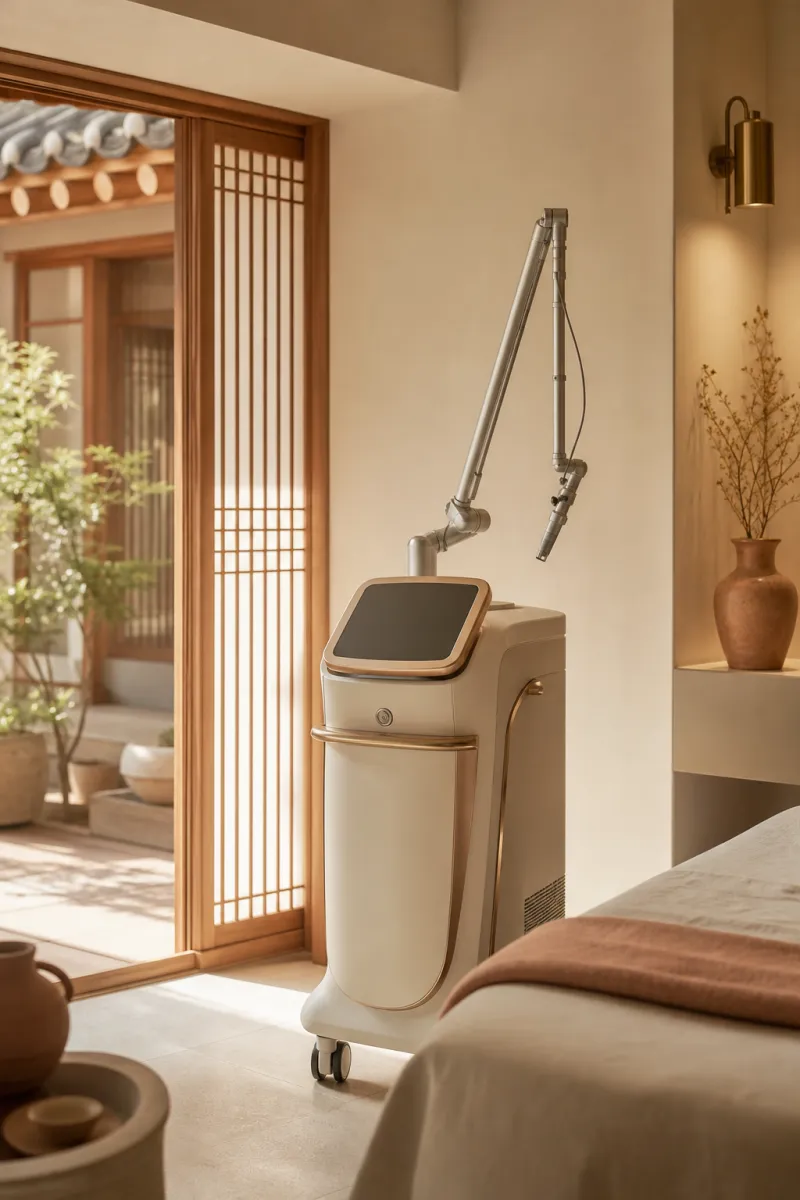
Pico laser in Korea is a picosecond laser that fires pulses short enough to shatter pigment with mostly mechanical force rather than heat, which makes it a strong option for deeper brown or blue-gray spots and stubborn ink. It is not automatically the right tool for every mark. Shallow freckles often clear with an older Q-switched nanosecond laser, and diffuse melasma is usually handled with gentle low-energy toning passes, whether nanosecond or picosecond. The choice depends on pigment depth, skin reactivity and how many visits your trip allows. Expect redness for hours to a few days and darkening of treated spots before they flake; flying home the same day is generally possible.
Guide
Picosecond, nanosecond and toning: what really differs
All three use laser light absorbed by melanin, so the difference lies in pulse length and energy. A picosecond pulse lasts trillionths of a second, a Q-switched nanosecond pulse roughly a thousand times longer. The shorter pulse cracks pigment into finer dust with less heat spreading into nearby skin.
Toning is a technique, not a device. The doctor runs a wide, low-energy beam evenly across the face, often with a Q-switched Nd:YAG at 1064 nm or a picosecond laser in toning mode, aiming for gradual lightening over a course.
| Feature | Picosecond spot mode | Q-switched nanosecond spot mode | Low-energy toning |
|---|---|---|---|
| Pulse length | Picoseconds | Nanoseconds | Either, at low fluence |
| Main action | Photoacoustic, little heat | Photothermal and mechanical | Gentle, repeated melanin disruption |
| Typical target | Dermal spots, ink, stubborn marks | Freckles and sun spots | Diffuse tone and melasma |
| Sensation | Sharp snapping | Sharp snapping | Warm prickling |
| Visible healing | Spots darken, then flake | Spots darken, then flake | Pinkness for hours |
Guide
Which pigment problem fits which laser
Depth decides most of the plan. Freckles and sun spots sit high in the skin and respond to either spot mode. Hori's nevus and nevus of Ota sit in the dermis, where the finer fragmentation of a picosecond pulse tends to matter.
A 2020 retrospective review by Koh and colleagues in Dermatologic Surgery followed Asian patients with skin types III and IV treated with a 755-nm picosecond laser. Nevus of Ota needed about two sessions on average and Hori's nevus nearly four, with a range of one to six. The authors reported faster clearance than their earlier experience with a Q-switched 1064-nm laser.
- Freckles and flat sun spots: picosecond or Q-switched spot mode
- Hori's nevus, nevus of Ota: picosecond spot mode, several visits apart
- Melasma: low-energy toning, often with medication and strict sun care
- Post-inflammatory darkening after acne or a burn: sunscreen, time and very gentle toning only
- Tattoo ink: picosecond spot mode, multiple sessions
Guide
Melasma and picosecond lasers: a cautious fit
Melasma is driven by hormones, sunlight and heat, so any laser that irritates the skin can darken it. Clinics therefore treat it with low energy and long courses rather than a strong spot pass.
A 2023 network meta-analysis by Ren and colleagues in Dermatologic Surgery pooled 20 studies with 1,182 patients. A 1064-nm picosecond laser combined with tranexamic acid showed the highest effective rate among the compared options. Melasma also tends to return, so maintenance and sun protection matter as much as the device.
Guide
Darker Asian skin and rebound pigment
Skin types III to V carry more melanin, which raises the chance of post-inflammatory hyperpigmentation after any laser. Patchy lightening, called hypopigmentation, is less common but possible, mostly after repeated aggressive toning.
In the Koh review, about 38% of patients had redness after treatment and one had temporary lightening; no lasting color change was seen. A test spot before full-face work is a reasonable request.
Guide
Planning picosecond sessions in Seoul
Toning visits are short and usually leave only pinkness for a few hours to a couple of days. Spot removal leaves small dark marks or fine crusts for about a week, so allow time before photos. Flying home is generally possible the same day, but sun exposure on a beach stop is a poor idea.
Before the visit, ask which spots get which mode and how many sessions the plan assumes. A full course rarely fits one trip, so many visitors start in Korea and continue on a later visit.
Evidence
Research behind this page
- Efficacy and Safety of Picosecond Laser in the Treatment of Melasma: A Network Meta-analysisDermatologic Surgery · 2023 · doi:10.1097/dss.0000000000003775
A network meta-analysis of 20 studies (1,182 patients) found that a 1064-nm picosecond laser combined with tranexamic acid had the highest effective rate for melasma among the compared approaches.
- Treatment of Laser-Responsive Dermal Pigmentary Conditions in Type III-IV Asian Skin With a 755-nm Picosecond Pulse Duration Laser: A Retrospective Review of Its Efficacy and SafetyDermatologic Surgery · 2020 · doi:10.1097/dss.0000000000002332
A retrospective review of 29 Asian patients found the 755-nm picosecond laser cleared nevus of Ota and Hori's nevus over a few sessions, with transient redness common and no lasting pigment change.
FAQ
Questions about Laser toning in Gangnam
Is a korea pico laser session right for a few freckles?
It can be, though a Q-switched nanosecond laser often clears shallow freckles just as well. Freckles sit near the surface, so both spot modes break the pigment, which then darkens and flakes over about a week. The picosecond option may need slightly less heat and fewer passes. Ask the treating doctor which device suits your spots and why, rather than assuming the newer one is needed for every brown mark.
What does pico laser treatment in Korea feel like?
Spot mode feels like quick rubber-band snaps, while toning feels like warm prickling across the face. Numbing cream is often applied before spot work and is optional for gentle toning. Sensitivity differs between people and between the cheeks, upper lip and nose, so tell the doctor when an area feels too strong. Cooling air or a cold pack afterward settles the stinging within minutes.
Is pico laser in Seoul suitable for olive or tan skin?
Yes, with care, because medium and darker skin has a higher chance of rebound darkening after any laser. Doctors usually lower the energy, widen the gap between sessions and may test a small area first. Strict sunscreen use before and after treatment lowers the risk further. Recent tanning is a reason to postpone, so avoid planning beach days just before your appointment.
Can pico laser in Gangnam remove a deep blue-gray birthmark?
Picosecond lasers are commonly used for dermal marks such as nevus of Ota and often lighten them over several visits. The 2020 Koh review in Dermatologic Surgery reported an average of about two sessions for nevus of Ota, with a range up to six. These marks need weeks between sessions for the skin to clear the fragments, so treatment usually spans more than one trip.
Why can spots look darker right after a picosecond session?
Treated pigment rises toward the surface and darkens before it sheds, which is a normal stage of healing. The marks usually form fine crusts that loosen within about a week when left alone; picking them can leave new marks. Gentle cleansing, moisturizer and daily sunscreen help until the skin settles. Ask the doctor when makeup and actives can go back on.
Who should avoid picosecond laser work?
People who are pregnant, have an active infection or rash on the area, or took isotretinoin recently should usually wait. A fresh tan, a history of keloids or a strong tendency to rebound darkening also needs a careful conversation first. Any changing or irregular mole should be checked medically before laser. Mention all medicines and recent peels at the consultation so the plan can be adjusted.